
Read Washtenaw Tax Record Fields
Read the year first. Values shift on their own schedules. A Washtenaw County tax record blends annual assessment facts with billing details, where the parcel card supplies the assessment fields and the Treasurer's linked services handle current and delinquent tax information.
| Field | What It Shows | Where |
|---|---|---|
| State Equalized Value | Equalized assessment for the stated year | County Parcel Search |
| Taxable value | Value to which authorized rates apply | Assessment record |
| Principal residence | Whether the listed exemption applies | Assessment record |
| Current tax | Bill and payment information | Local treasurer path |
| Delinquent tax | Tax transferred to county collection | County Treasurer / BS&A |
SEV, taxable value, and sale price answer different questions. Michigan ties assessment to half of true cash value. Taxable value follows Proposal A rules instead, and any sale entry still needs confirmation against the recorded deed.
Split Washtenaw Tax Searches
Washtenaw County splits tax lookup into two official channels. The county tax-search hub routes visitors to separate services for current and delinquent tax. Delinquent collection now runs through BS&A/AccessMyGov. It accepts address, name, and parcel-number queries. Search both paths whenever a history crosses the handoff between local and county collection.
Save the retrieval date, tax year, municipality, and parcel number. A current bill does not rule out an older delinquency. Portal tools that let users claim saved properties are conveniences, not proof of ownership. Treat them accordingly.
The official BS&A tax service shows the distinct current and delinquent record choices.
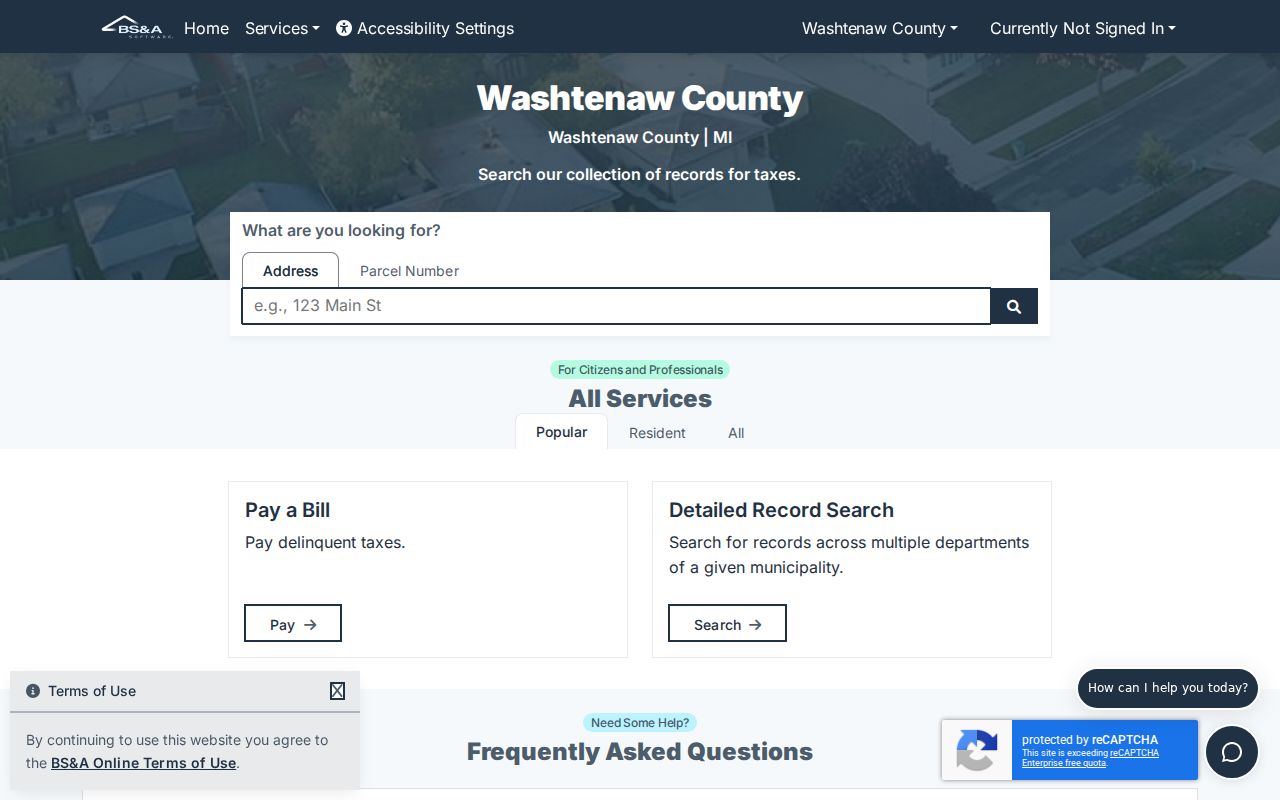
The right tax path starts with the parcel number.
Compare Washtenaw Value Terms
The local assessor sets the assessed value. State equalization produces the SEV figure. Taxable value is the base that millage rates actually apply to, after statutory limits and adjustments. A sale price is transaction evidence, and it never converts into these figures automatically.
- SEV
- The equalized value, generally associated with half of true cash value.
- Taxable value
- The figure used with authorized millage rates.
- Millage
- A tax rate expressed in mills.
- Principal residence exemption
- A statutory exemption affecting specified school operating taxes.
Note: Compare figures from a single year, because mixing a current taxable value with an older sale price creates a false contrast.
Look Up Washtenaw Tax Bills
Start with the county parcel search. Use it when the parcel number or governing municipality is unknown; it accepts taxpayer name, street, number or range, municipality, and the full parcel identifier. Carry that number forward.
- Find the parcel and confirm the city, village, or township that assesses it.
- Open the current-tax service and record the bill year and payment status.
- Use the county route for amounts transferred to delinquent collection.
- Compare SEV, taxable value, and principal-residence status with the assessment card.
- Check live foreclosure material if an advanced delinquency is flagged.
The taxpayer and mailing address on the annual card may not match the newest deed. A later closing can appear in land records first.
If an address fails, drop the street suffix. Try a number range, and confirm the municipality. Washtenaw County postal names can cross governmental lines, so an Ann Arbor mailing address may lead to a township assessment. Taxpayer queries work best with the last name first. The full twelve-character parcel number is the strongest key when moving between the assessment and tax services.
Distinguish Washtenaw Sale Evidence
A parcel card may show a sale date, price, and liber/page reference. Treat those as leads. The recorded deed is the transaction-level source, and transfer terms shape how a price should be read. A nominal or family transfer carries none of the market weight of an arm's-length sale.
The tax roll supports taxation, not a private appraisal. Verify the deed reference when the sale matters. Keep the record year with everything.
Review Washtenaw Tax Delinquency
Washtenaw County lays out its collection, foreclosure, auction, and assistance routes on the county's property-tax information page. Delinquency moves to the county after March 1. A three-year foreclosure sequence follows. The live county record controls. Dates, fees, interest, and parcel status all change, and foreclosure records settle no title, access, lien, zoning, or condition question, so review the deed, map, and municipal records before any purchase decision.
Auction records require due diligence. A minimum bid or SEV-derived figure does not establish market value, clear title, access, or buildability.
Read Washtenaw Auction Records
The official county auction story map presents parcel cards with identifiers, mapped context, acreage, minimum bids, and an SEV-derived figure. A sample parcel at 12 Ohio Street in Ypsilanti Township shows why each field must stay in its own lane. None of the entries proves post-sale status.
Rely on live auction terms, not saved inventory. Parcels, dates, and conditions change. Keep the card beside a fresh tax search and the recorded instrument trail.
Check Washtenaw Exemption Status
The assessment card can show principal-residence status and special-assessment information. Those entries shape tax treatment. They do not establish who physically occupies a property. Compare the exemption year with the taxpayer fields, and contact the local assessing unit when a filed correction has not appeared.
Drain and special-assessment charges may follow their own paths. Use the parcel number and municipality in any request. Attach the notice, year, and disputed field so staff can find the record.
Assessment work is shared between local and county roles. Local units create and defend parcel assessments. County equalization reviews totals and reports countywide values. The official 2026 equalization material reported about $33.68 billion in real property and about $24.94 billion in residential property. Those aggregates show scale only. They cannot value a single parcel.
Keep the assessment notice, bill, receipt, and portal result as separate records. Their dates reveal which office acted, which year applied, and whether a later correction reached every system.
Contest a Washtenaw Assessment
An appeal starts with your assessment notice and the local assessing unit in Washtenaw County. The core path runs through Michigan form L-4035 and the March Board of Review. Meeting dates and filing deadlines are set locally and shift from year to year. Build a real case. Bring comparable sales, photographs, an appraisal, factual corrections, and a plain statement of the value you dispute.
File with the actual city or township, not just the postal city name. Keep proof of delivery and the board's written decision. A later Michigan Tax Tribunal appeal may hinge on two things. One is the property type. The other is the steps you took first.
Appeal window. Check the current local March Board of Review notice at once. Missing an applicable filing step can limit later review.